September 2013Click any article link:
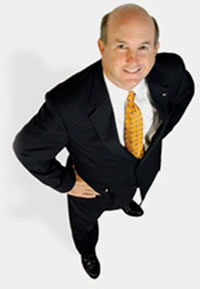
George Hedley Will Be Convention Keynote SpeakerAs a general contractor and business owner for over 30 years, George Hedley, CSP, is one of the top construction business speakers and industry experts. He is often called “The Construction Business Builder” and specializes in presentations to help construction company business owners, managers, contractors, subcontractors and suppliers build organized and systemized companies that make a profit. As a construction business speaker, Hedley helps construction business owners and entrepreneurs get their business to work for them without their constant supervision. He also specializes in business building programs for businesses who sell to contractors such as wholesale distributors, banks, insurance and financial service companies. George Hedley's experience starting, growing & building his $50 million construction business into an organized management-run company enables him to show you what works today. His hands-on experience running his profitable construction company will help your organization build people and leaders, create long-time repeat loyal customers, focus on priorities that really count, install systems to always make a profit and continuously improve. Hedley, one of the top motivational business speakers in the USA, is the author of "Get Your Business To Work!" "On-Purpose…On-Target!" and "The Business Success Blueprint" series. Today, along with managing his development and construction company, he owns HARDHAT Presentations and speaks to national organizations, associations, conventions, company meetings, leadership conferences and customer retreats. He provides inspiring motivational keynote speeches, offers 'nuts and bolts' business seminars and 'how-to' management and leadership workshops for business owners, executives, decision makers and managers. He is a regular columnist in Construction Business Owner magazine and has authored Everything Contractors Know About Making A Profit! Make plans today to attend the convention so you don’t miss this informative talk!
SEAA Training Committee Meeting on September 25th - back to top
|


|

|

|

|
Check us out and Like us or send a comment.

September Golf Tournament - back to top 
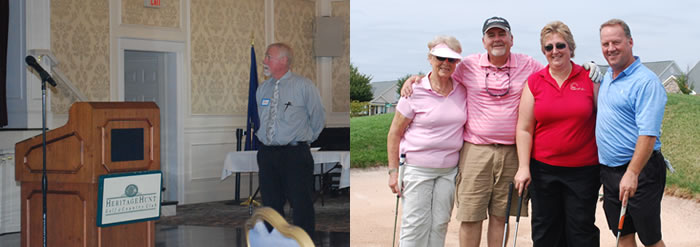
Left: Dean McKenzie, Office Director of Construction Services – OSHA;
Right: Marilyn Pocock-Embrey, Chip Pocock, Stephanie Trainor and Gene Stewart
By Carrie Sopuch-Gulajan, SEAA Board Member
The 2nd Annual George R. Pocock Memorial Golf Tournament hosted by SEAA-MAC (see photos HERE) was a huge success. Prior to the tournament, the day started with an OSHA Roundtable discussion. Dean McKenzie, Office Director of Construction Services with OSHA, discussed multiple topics including fatality rates, frequently cited standards, an update on the Directorate of Construction Standards, and an in-depth discussion on crane standards. We are looking forward to working with Dean and furthering SEAA’s relationship with OSHA.
After lunch was served, more than 70 golfers teed off on a bright and sunny afternoon. It was the perfect golf weather. Although no one won the “hole-in-one” prize, a TRUCK, we did have one golfer get within 8 feet of the hole. Others only dreamed of owning a new truck and that was short lived. After a fun-filled afternoon we all shared great stories about George over a few more cocktails and hors d’oeuvres.
I want to extend a special thank you to Pete Walker, Paul Kollman and Terri Gaither of Phoenix Steel Erectors for handling the brunt of the work preparing for this SEAA-MAC event. None of this would be possible without all of our friends and sponsors who continue to support this event every year. It would have pleased George to know how much he’s missed and that SEAA continues to strive for even a bigger and brighter future.
For those of you who missed this event, there is still another opportunity to golf in 2013. SEAA will be hosting the 14th Annual Educational Fund Raiser Golf Tournament on October 18th in Raleigh, NC. I hope to see you there.
Get Ready to Submit Your Work for SEAA Project of the Year - back to top
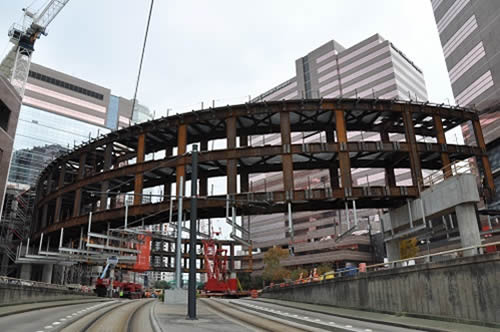
For more than 10 years, SEAA has recognized complex and unique steel erection projects throughout the world. Past winning projects demonstrated successful completion while overcoming unusual conditions, tight time constraints, or other challenges. Many of the jobs that have been recognized are public works projects, including bridges, highways, and overpasses. Others are new construction of museums, hospitals, sports arenas, airports, and more. One of your current projects could be a winner!
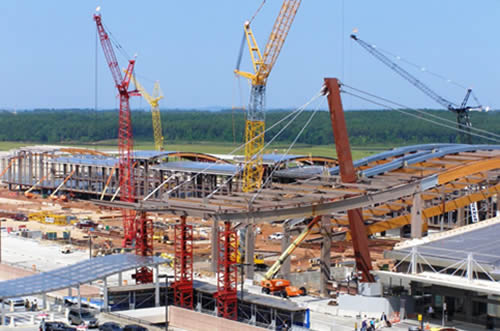
Projects are recognized in three categories: Over $1 million, $500,000 to $1 million; and up to $500,000. So check out the nomination form, get your photos ready, and plan to nominate your project. Project winners are announced at the SEAA Convention & Trade Show, March 12-14, 2014 in Dallas, TX.
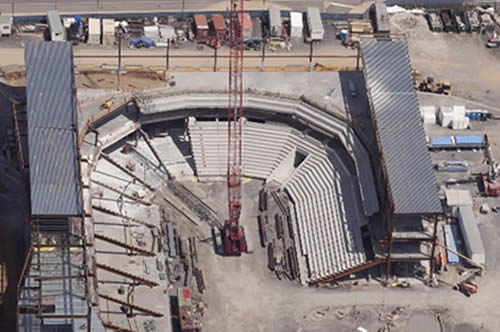
Check out previous winners on our website.
For information on entering a project:
Schulz Iron Works Once Again in the Media - back to top
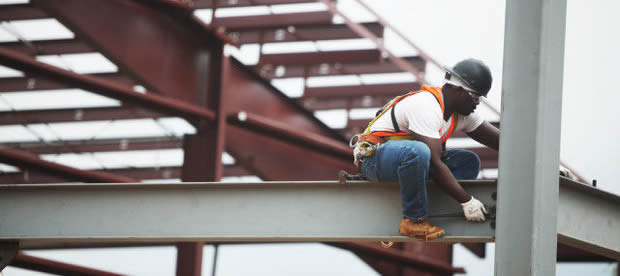
Jason Corey of Schulz Iron Works "bolting up" at one of the company's current project sites, Halifax Park and
Community Center in Raleigh on Thursday, August 1, 2013. Photo courtesy of Raleigh News & Observer.
SEAA member, Schulz Iron Works, was once again quoted in the Raleigh (NC) News & Observer on the topic of how small businesses make sure their invoices get paid. You can read the full article HERE.
INDUSTRY |
|||
Focus on Safety and Efficiency at World Crane and Transport Summit - back to top
|

|
Note to SEAA Members If your business or organization is hosting a SteelDay event this year, please send SEAA a description of your event and photos (with captions) so we can include them in SEAA Enews. Send your information and photos to [email protected]. |
Buckner Companies Adds Two Crawler Cranes to Heavylift Fleet - back to top
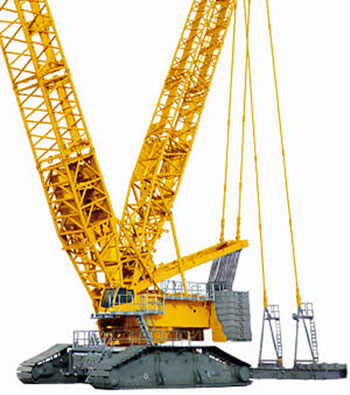 |
Buckner Companies has expanded their Heavylift crane division with the addition of two of Liebherr’s newest crawler cranes, the LR 11000. The LR 11000 has been designed from the ground up to provide a small footprint for work in constricted areas such as refineries, as well as keeping component weights and dimensions small enough to allow for easy and rapid transport. When recently shown at Bauma 2013, the assembly crew proclaimed the LR 11000 went together as easily as a 600-ton class machine, despite its massive rating of 1102 US tons. In addition to impressive lifting capacities, the LR 11000 comes with a wide array of boom configurations, including the innovative new PowerBoom, or “P-boom” as it is known. The P-boom allows for a drastic increase in lifting capacity up to 1432 US tons, nearly matching that of the LR 11350. When combined with a derrick and tray or wagon, the LR 11000 / P1300 puts Buckner Heavylift Cranes in an entirely new class of lifting capacity. |
SAFETY |
|
OSHA and SAIA Produce Mobile Scaffold Tip Sheet - back to top
|
 |
A new “Rolling Towers/Mobile Scaffold: Inspection, Maintenance, and Use Tip Sheet” is now available through the collaborative effort of the Occupational Safety and Health Administration (OSHA) and the Scaffold & Access Industry Association (SAIA) Alliance. This tip sheet can assist workers in the proper inspection and maintenance of rolling tower/mobile scaffold.
"The publication of the rolling tower/mobile scaffold tip sheet is a significant step forward in the industry's goal of getting crucial safety information into the hands of the person who requires it most, the worker," said Marty Coughlin, SAIA president. "The OSHA Alliance process is an essential component of industry outreach, and the SAIA's Alliance program has produced a substantial amount of quality safety information. The scaffold and access industry can only benefit from this process, there is no down side to prevention of accidents, and credit must go to both the OSHA and SAIA's Alliance team, who have combined to produce a concise and productive process."
This tip sheet adds to the collection of complimentary OSHA and SAIA tools for scaffold and access workers. The documents are available for download on the SAIA's website: www.saiaonline.org/OSHAAlliance.
LAWS & REGULATIONS |
||||
Holding the Bag--Chip Pocock Discusses the Crane Operator Certification Controversy - back to top
|
 |
 |
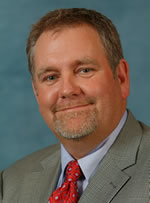
Chip Pocock is safety/risk manager of Buckner Companies, a NCCCO certified crane operator and practical examiner, and was a member of the OSHA Crane and Derrick Advisory Committee. He is a former president of SEAA.
|
AISC Response to Question about OSHA Position on “Pour Stop Angles” - back to top
 |
Roger E. Ferch, president of the American Institute of Steel Construction (AISC), was asked to respond to the OSHA position of “pour stop angles” by Steven Rank, executive director of the International Association of Bridge, Structural, Ornamental and Reinforcing Iron Workers. Ferch gave SEAA permission to reprint his response letter with this introduction: “From time to time I get requests from the Ironworkers to support a position with OSHA. First, I try to ascertain if it is an industry issue (on which I will take a position) or a union/non-union issue (on which I remain silent).”
Ferch’s letter emphasizes that “pour stop angles” are not a tripping hazard as OSHA had maintained and “they provide a barrier similar to a toe plate installed on a perimeter safety railing to help prevent objects from falling from the working floor….” Ferch further states that “not allowing the shop installation of these devices significantly increases the exposure to injury on the jobsite.”
SEAA President Steve Burkholder affirms Ferch’s approach, stating, “SEAA is glad to support AISC on this point with OSHA.” Ed Valencia, SEAA Board Member, agrees and says, “’Pour stop angles’ are not tripping hazards and should be allowed.”
Ferch spoke at a recent SEAA Board of Directors’ meeting in Chicago, a demonstration of the good working relationship between the two organizations, reported Board member, Jim Larson. Larson also commented on Ferch’s letter: “This is indeed good news for the positions long stated by SEAA.”
Read the full text of Ferch’s response HERE.
TRAINING |
||||||||||||||
Training Requirements for OSHA’s Hazard Communication Standard - back to top
|
 |
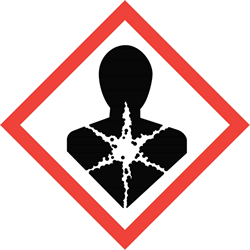
To help members comply with these new requirements, SEAA member LPR Construction has graciously agreed to share its GHS (Globally Harmonized System) video, which is available in the Members section of the SEAA website HERE (login required). You can meet the OSHA requirements by showing your employees this video, then documenting the training with a signed attendance form or a company certification card. The video is also available to non-members for a fee. Call the SEAA office at 336.294.8880 for information and cost.
To better protect workers from hazardous chemicals, the U.S. Department of Labor's Occupational Safety and Health Administration (OSHA) has revised its Hazard Communication Standard, aligning it with the United Nations' global chemical labeling system. The new standard, once implemented, will prevent an estimated 43 deaths and result in an estimated $475.2 million in enhanced productivity for U.S. businesses each year.
"Exposure to hazardous chemicals is one of the most serious dangers facing American workers today," said Secretary of Labor Hilda L. Solis. "Revising OSHA's Hazard Communication Standard will improve the quality, consistency and clarity of hazard information that workers receive, making it safer for workers to do their jobs and easier for employers to stay competitive in the global marketplace."
The revised Hazard Communication Standard is being phased in and will be fully implemented in 2016. Following are specific requirements and phase-in dates to help employers comply:
December 1, 2013 —Train employees on new label elements and SDS format.
June 1, 2015 —Comply with all modified provisions of this final rule.
December 1, 2015 —Final deadline for distributors to ship products labeled under the old system.
June 1, 2015 —Update alternative workplace labeling and hazard communication program, as necessary, and provide additional training for employees on newly identified physical or health hazards.
During the transition period to the effective completion dates noted in the standard, chemical manufacturers, importers, distributors and employers may comply with either 29 Code of Federal Regulations 1910.1200 (the final standard), the current standard or both.
This revised rule will benefit workers by reducing confusion about chemical hazards in the workplace, facilitating safety training and improving understanding of hazards, especially for low literacy workers. OSHA's standard will classify chemicals according to their health and physical hazards, and establish consistent labels and safety data sheets for all chemicals made in the United States and imported from abroad.
The revised standard also is expected to prevent an estimated 585 injuries and illnesses annually. It will reduce trade barriers and result in estimated annualized benefits in productivity improvements for American businesses that regularly handle, store and use hazardous chemicals, as well as cost savings of $32.2 million for American businesses that periodically update safety data sheets and labels for chemicals covered under the standard.
 |
|
"OSHA's 1983 Hazard Communication Standard gave workers the right to know. As one participant expressed during our rulemaking process, this update will give them the right to understand, as well," said Assistant Secretary of Labor for Occupational Safety and Health Dr. David Michaels. The Center for Construction Research and Training (CPWR) has downloadable training materials on their website. |
Short Course on Cold-Formed Steel Design - back to top

Click here for a pdf copy of the short course flyer and registration form.
About the Course
This short course will discuss the behavior of cold-formed steel members and connections. The short course is structured to provide an introduction to behavior and design for the engineer unfamiliar with cold-formed steel. For engineers experienced with cold-formed steel design, the short course will strengthen their understanding of the fundamental behavior of both members and connections, as well as provide a better understanding of the AISI design specification and the AISI framing standards. A preview of future specification changes will also be provided. Both commercial and residential applications of cold-formed steel will be discussed.
Texts & References
Lectures will be based on information contained in the AISI North American Specification for the Design of Cold-Formed Steel Structural Members and Commentary, 2012 edition. The text Cold-Formed Steel Design, 4th edition, by Wei-Wen Yu and Roger A. LaBoube, will also serve as a course reference.
Topics Covered in the Training
Tuesday, October 15
Mechanical Properties of Steel and Effect of Cold-Work of Forming
Local Buckling and Postbuckling Strength of Thin Flat Elements
Tension Members
Flexural Members - Bending Strength and Deflection
Flexural Members - Distortional Buckling
Wednesday, October 16
Flexural Members - Web Design
Flexural Members - Lateral Buckling
Compression Members - Flexural, Torsional and Torsional-Flexural Buckling
Bracing Requirements
Compression Members - Distortional Buckling
Q and A and General Discussion
Thursday, October 17
Beam-Columns
Direct Strength Method
Connections
Cold-Formed Steel Framing Standards
Cold-Formed Steel Framing Applications - Example Problems
|
Continuing Education Credits: 2.4 CEUs |
Instructors
Roger LaBoube, PhD, PE ; Curators' Teaching Professor Emeritus of Civil Engineering at Missouri University of Science and Technology and Director of Wei-Wen Yu Center for Cold-Formed Steel Structures
Sutton Stephens, PhD, PE, SE; Chief Structural Engineer at Pacific Northwest Engineering, Inc.
Registration & Fee
The registration fee of $1095.00 per person includes textbooks, course notes and three lunches (exclusive of room and board). Check purchase/money order or credit card information for the fee should accompany each application. Advance registration is requested and should be completed prior to October 1, 2013.
Location and Accommodations
This short course will be held at the Drury Plaza Hotel at the Arch 2 South 4th Street in downtown St. Louis, Missouri.
This historic property is an elegantly renovated former hat factory which is located just around the corner from the St. Louis Gateway Arch and just a few blocks from many other downtown and riverfront attractions. Amenities include a free hot breakfast and free wireless Internet. Click here to see a full list of the hotel services and extras.
Sponsored by:
|
|
|
|
|
|
|
|
|
|


If you have any questions please contact us at Tel: (573) 341-4471, Fax: (573) 341-4476, e-mail [email protected].
The Center for Cold-Formed Steel Structures (CCFSS) was established at the University of Missouri-Rolla (now Missouri University of Science & Technology) in May 1990 under an initial grant received from the American Iron and Steel Institute. The Center's sponsors now also include Cold-Formed Steel Engineers Institute, Metal Building Manufacturers Association, Metal Construction Association, Rack Manufacturers Institute, Simpson Strong-Tie, Steel Deck Institute, Steel Framing Industry Association and Steel Stud Manufacturers Association.
The Center, renamed for its Founding Director Dr. Wei-Wen Yu in 2000, provides an integrated approach for handling research, teaching, engineering education, technical services, and professional activity. The Center brings together the technical resources of interested parties such as university researchers, steel producers, product manufacturers, consultants, building officials, government agencies, and others with a common goal of continued improvement of cold-formed steel design and construction.
Power Generation Lifting Workshop to Be Held November 6-8 in New York City - back to top

Industrial Training International is presenting the Power Generation Lifting Workshop in New York City, November 6 - 8, 2013. The curriculum will tightly focus on construction and maintenance lifting activities conducted in power generation environments including nuclear, oil, gas, hydro power stations, and wind energy.
Here are 8 reasons to attend:
- Mike Parnell, ITI President & CEO
Vice Chair, ASME B30 (Cranes & Rigging)
Chair ASME P30 (Lift Planning) - John Groce, P.E., WireCo World Group Senior Technical Service Engineer
Committee Member, ASME B30.30 Ropes
B.S. Mechanical Engineering, University of Missouri - Geoff Holden, LEEA Chief Executive
Director, Institute of Association Management
Former Manager, Bridon International - John Newby, The Crosby Group Senior Instructor
B.S. Engineering Physics, University of Michigan
M.S. Astro Physics, University of Toledo - Jeff Roach, American Electric Power Learning Coordinator
- Don Strong, P.E., Vestas American Wind Technology Senior Mechanical Engineer of Transportation, Execution & Field Support
M.S. Mechanical Engineering, University of Maine - Julian Thompson, General Supervisor Mechanical Maintenance at Nine Mile Point Nuclear Station, Constellation Energy, an Exelon Company
- Jim Yates, P.E., Barnhart Crane & Rigging Senior Vice President of Engineering & Technical Services
Committee Member,ASMEB30.1 (Jacks, Rollers, Casters)
Committee Member, ASME P30 (Lift Planning)
For more information visit iti.com/workshops or call 1-800-727-6355 to speak with a workshop representative today.
Tilt-Up Concrete Association Convention to Include Erection & Rigging Training - back to top

The Tilt-Up Concrete Association (TCA) Annual Convention, scheduled for September 30 - October 2, 2013 in Houston, TX, will include erection rigging and training that can benefit SEAA members. This training will take place Wednesday, October 2, 2013 - 10:30 - 11:30 am. Presenters will be Barclay Gebel of Concrete Strategies and Gary Fischer of Woodland Construction.
Description of the Training
The new TCA safety guideline provides the basis for the TCA’s Erection and Rigging Training Program, produced by the TCA Safety Committee. The program, which will be offered for the first time at the TCA Annual Convention in Houston, Texas, presents issues specific to the rigging and lifting of tilt-up panels.
The Occupational Safety and Health Administration (OSHA) requires crane operations to involve qualified persons for rigging and signaling the certified crane operator. To further industry preparedness and assuredness of this requirement, the TCA Safety Committee established itself as a third-party Qualified Evaluator for participants in the program.
During the program delivery, demonstrations of the most common rigging equipment and connections are made. Safe and unsafe conditions are addressed as well as inspection points for the required equipment. Additionally, attendees to the program are given the signals essential to the lift operation and unified to the responsibility for hand signal communication as well as the proper positions for maintaining line of site. Attendees will also learn the essential activities and restrictions for all persons on the site during a lift, ensuring that no worker is out of position or located in an unsafe or unprotected situation.
“The TCA safety guideline provides the background and documented support for continued commitment to safety on tilt-up sites,” states James Baty, Technical Director for the TCA. “However, in order to more fully prepare industry participants to meet OSHA’s regulations and more importantly, protect their workforce, it was essential for this committee to set in motion this training program and be able to communicate the necessity of a plan to both our members and the industry at large.”
During the program, attendees will also be equipped to develop a quality tilt-up safety plan:
- Assessment of site conditions and planning
- Review of panel and building design against existing preparation
- Description of the special procedures required for hazardous non-routine tasks
- Bracing manual should be obtained
- Description of panel casting and erection activities and procedures
- Direction to obtain the erection subcontractor and crew experience
- Direct training essential for all members of the crew
- Review of crane capacity and mobility
- Agenda and schedule for safety meetings
- Schedule for inspections of rigging equipment and crane
- Review of fall protection and hazard training
- Plan for lifting and maneuvering panels and crane positioning
- Schedule for inspections of bracing equipment and removal timing
To learn more, download the complete 2013 Convention Brochure.

 RSS Feed